
Fellow Tarnished, after countless hours in the Lands Between – bosses buried, the game finished more times than you’d admit out loud – you can hit a strange wall. Not a difficulty wall. An expectation wall.
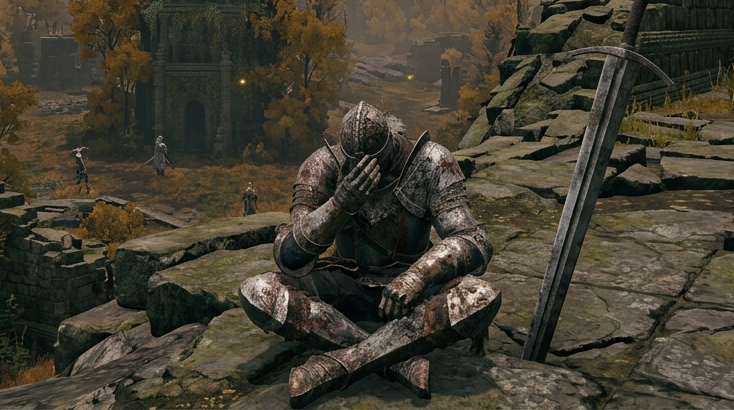
You become a victim of your own standards, and the frustration lands harder than anything Malenia ever threw at you.
Sound familiar? Let me explain what I mean.
The trap you built yourself
You roll a fresh character. New build, new weapon, a plan you sketched out before you even booted the game. You’ve done this before. You know the moveset windows. You’re not calling in Mimic Tear anymore, because that started feeling like cheating somewhere around your seventh playthrough.
You walk into the fog. You expect to smash this boss.
The boss smashes you instead.
And again. And again. Not in a fun way, but in the way that makes you sit back in your chair and quietly ask what the hell is wrong with you. You know this fight. You’ve won it before. So why does the health bar refuse to move?
Then, twenty attempts later, you finally win. And nobody warns you about the next bit: there’s no rush. No fist pump. No shouting at the screen. Just a flat, tired “finally”, followed immediately by why did that take so long?
Pay attention to that moment. Beating a boss has stopped feeling like an achievement and started feeling like clearing a debt.
The Honest Bit
There’s a second half to this, and it stings a little.
You’ve probably complained – maybe out loud, maybe just internally – that certain bosses still give you trouble after all this time. Crucible Knights, still shield-bashing you into a corner. The Fallingstar Beast, still catching you with that charge you swear you rolled.
But if you’re being honest with yourself, have you ever actually learned them?
Or did you brute-force it? Again. And again. Overlevel a bit, upgrade the weapon a bit, throw yourself at the wall until the wall gave up first. That works. Elden Ring lets it work. Part of the game’s generosity is that there’s almost always a way to bulldoze through.
Trouble is, bulldozing doesn’t teach you that fight. You get better at a lot of things across five playthroughs, but the specific reads for this specific boss aren’t among them, because you never actually practiced them. You just brought more health and a sharper sword each time. And when a run comes along where the raw numbers aren’t there to lean on, the gap shows, and it feels like you’ve gone backwards.
You haven’t. You just never built this one particular thing, while quietly getting better at almost everything else.
The Part You’re Not Giving Yourself Credit For
So let’s talk about everything else, because there’s a lot of it.
Think about what you did in your first hours. You panic-rolled into attacks instead of away from them. You emptied your entire flask supply on the Tree Sentinel and called it a strategy. You held a shield up and hoped.
You don’t do any of that now. You read wind-ups. You know which combos have a fourth hit. You’ve internalized roll timings so thoroughly you don’t think about them, and that’s exactly the problem: things you don’t think about don’t feel like skills. They feel like the floor. Nobody’s proud of a floor.
So your improvement is invisible to you, while every single failure is loud and obvious.
Then there’s the other half of the calibration problem – what you’re measuring yourself against.
If you watch high-level Elden Ring content, and most of us do, your mental picture of “playing well” has been assembled out of clips. Level 1 no-hit runs. Bosses stance-broken over and over like it’s on a schedule. Someone beating Malenia with a dance pad. None of that describes normal play. It’s the top fraction of a percent of a playerbase of many millions, showing you their best attempts, edited down.
You’re not seeing the eight hours of failure behind the two-minute clip. Nobody uploads those. Then you sit down, die eleven times to Crucible Knight Ordovis, and conclude something is wrong with you.
Nothing’s wrong with you. You’re comparing your unedited raw footage to somebody else’s highlight reel.
Try measuring yourself against you instead. Not against a streamer, not against some imagined “average player” who doesn’t exist. Go back and fight something from early Limgrave that once ruined your week. Watch how fast it dies now. That’s your actual progress, and it’s the only comparison that means anything.
Why the Joy Leaked Out
Three things tend to be happening at once when this hits:
You changed the difficulty and forgot to change the expectations. Dropping Spirit Ashes is a real, meaningful step up. If you’ve removed one of the game’s strongest tools but still expect your old attempt counts, you’ve set yourself an unfair exam and are now marking yourself down for failing it.
A new weapon class is a new skill, not a stat change. Going from a katana to a colossal hammer isn’t like changing shoes. Reach, stamina cost, recovery time, what you can punish and what you can’t – all of it resets. The timing you built over hundreds of hours now works against you, because it’s the timing for a different weapon. Feeling clumsy isn’t failure, it’s the correct starting condition.
Familiarity killed your reward loop. The first time you drop a boss, your brain hands out a small chemical party. The eighth time it doesn’t, because your brain has filed the whole thing under routine maintenance. The game didn’t get worse. You need a different reason to be there.
So How Do You Get the Joy Back?
Nothing here is secret tech. It’s mostly permission to play differently.
1. Actually Learn One Boss. Properly.
Pick the fight that’s always given you trouble – say, a Crucible Knight – and go into the next attempt with zero intention of winning. Your only job is to watch. Which attack has the long wind-up? Where does the combo end? What does it do when you heal, punish or reset?
Die a few times on purpose while you learn. Enemies in Elden Ring have a hidden Stance value, and every attack you land chips away at it until they break and open up for a critical hit. How much stance damage a given move deals varies from attack to attack, and it isn’t tied to how much health damage it does. You can’t see that meter, but you can learn its rhythm on a specific boss. That’s real knowledge, and it transfers.
Ten focused attempts will do more for you than a hundred panicked ones.
2. Trade Damage for Information
If you’ve been living on jump attacks, know what you’re trading. Jumping strong attacks push extra stance damage, but you’re far more likely to get staggered if something clips you mid-air, and you’re left exposed for a moment after you land. Great deal when you know the opening is real. Terrible deal when you’re guessing.
And if you’re guessing every time, there’s your answer about whether you’ve learned the fight.
Try a run where you deliberately use tools you’ve ignored. Guard counters are a good candidate: block an incoming attack with a shield or in two-hand stance, then press strong attack for a counterattack. If you’ve spent a thousand hours rolling and never leaned on this, it’s basically a new game mechanic sitting in your pocket.
3. Change the Goal, Not the Difficulty
You don’t have to make it harder to make it interesting. Some things that tend to work:
- Themed builds. Not “optimal” – thematic. A pure Perfumer. Nothing but weapons found in one region. A single Ash of War for the whole run.
- Route weirdness. Go somewhere absurdly early. Take on an area completely out of order and watch the game bend.
- Co-op. Underrated as a mood reset. Helping someone else fight their wall is a completely different feeling from grinding your own.
- Invasions and PvP. Human opponents don’t have memorized movesets, which cuts straight through the routine problem.
- Nightreign. Sometimes the fix isn’t a new build but a different structure entirely. Short runs, forced adaptation, no chance to over-prepare.
4. Stop Counting Attempts
Simple, and the hardest one here. The attempt counter is not a scoreboard. Nobody is watching. There’s no leaderboard entry for “beat Radabeast in four tries.”
The moment you started treating attempt counts as a performance metric, you turned a hobby into an appraisal and appointed yourself the most hostile reviewer you’ll ever meet.
5. Take an Actual Break
Not a “I’ll play something else for an hour” break. A real one. Two weeks. A month.
The Lands Between will be exactly where you left it. Mechanical knowledge doesn’t evaporate; the reflexes come back within a session. What comes back after a break is the sense of the place being strange and enormous again, which is what you fell for in the first place.
The Real Point
You didn’t get worse. You picked up expectations that no longer match what you’re doing, and a definition of success – win fast, win clean – that has nothing to do with why you started playing.
The version of you who first stumbled into Limgrave wasn’t good at this game. That person had a magnificent time anyway. They weren’t measuring anything. They were looking at a big glowing tree, wondering what was over the next hill.
That player is still available. You just have to stop grading them.
Go get lost somewhere. Fight something you have no business fighting. Die stupidly and laugh about it.
That’s the game.
If you liked this post, you may want to check out our other Guides & Tips as well.
Leave a Reply